


For audio of the press conference, click here and here. For a copy of the report, click here. For data, click here.
Washington, DC – At a time when the Trump Administration is proposing sharp cuts to the U.S. Environmental Protection Agency (EPA), claiming that states can take on more responsibility for environmental oversight, more than half of states (27) have cut their environmental agency budgets over the last 15 years, suggesting they may not have the capacity to shoulder this additional work and protect the public from air and water pollution.
This is the conclusion of a new report by the Environmental Integrity Project titled, “State of Decline: Cuts to State Environmental Agencies Compound Damage from the Dismantling of EPA.”
The deep reductions at the state level mean that the Trump Administration’s planned downsizing of the EPA – with a vote by Congress planned next month on a proposal to slash EPA’s budget – will have an increased impact on pollution control efforts across the country. Not only will the federal pollution cop no longer be on the beat, state authorities may not show up either — because state inspectors have also been laid off in some areas.
EIP’s report found that seven states – including Texas, with its rapidly growing oil and gas industry – reduced their pollution control funding by at least a third from 2010 through 2024, when adjusted for inflation. The steepest cuts were led by Mississippi’s decision to slash its environmental agency by 71 percent, South Dakota’s 61 percent cut, and Connecticut’s 51 percent reduction. (See list and map below.)
Almost two thirds of states (31) also cut jobs at their environmental agencies from 2010 through 2024, eliminating 3,725 positions over this period, with North Carolina imposing the steepest percentage cuts (32 percent), followed by Connecticut (26 percent), Arizona (25 percent), and Louisiana (24 percent).
“The Trump Administration is attempting to dismantle EPA and rollback commonsense federal pollution rules, claiming that the states can pick up the slack and protect our communities – but that’s not the case,” said Jen Duggan, Executive Director of the Environmental Integrity Project. “The implementation of our environmental laws depend on both a strong EPA and state agencies that have the resources they need to do their jobs. But our research found that many states have already cut their pollution control agencies and so more cuts at the federal level will only put more Americans at risk.”
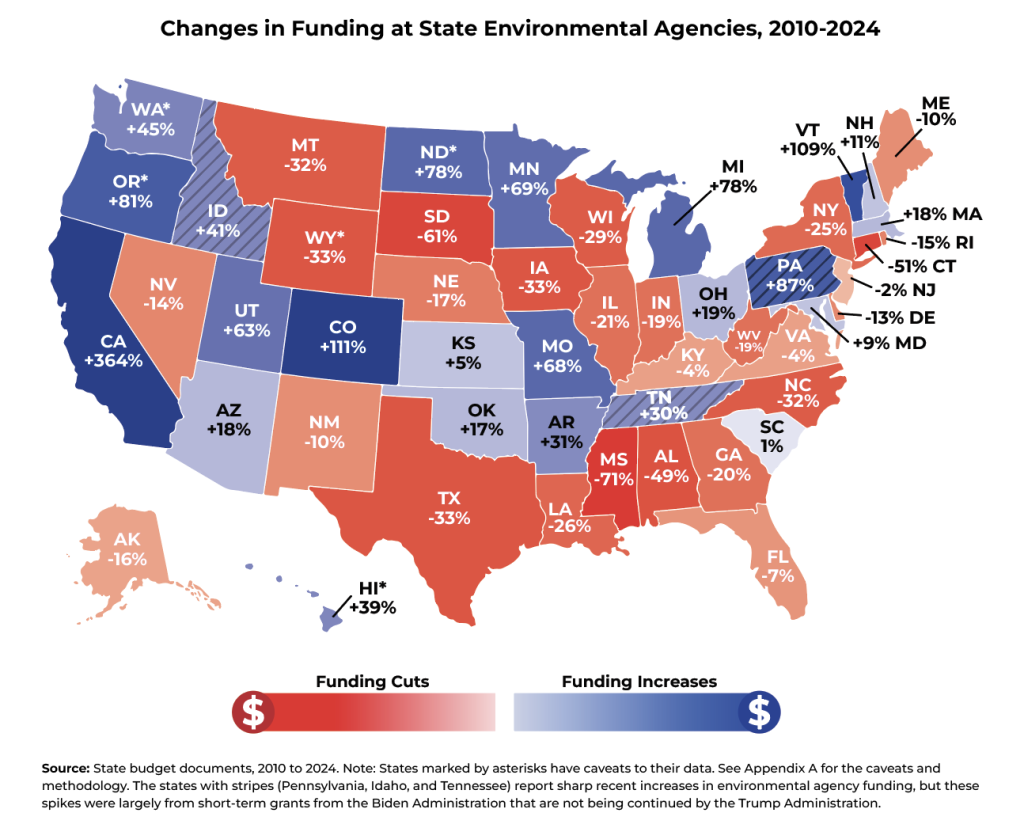
EIP’s report includes case studies of the impact of changes to state environmental agency budgets in Texas, Louisiana, Pennsylvania, North Carolina, Illinois and California.
California led a handful of states — including Colorado and Vermont — that have dramatically increased funding for their environmental agencies since 2010. In part as a response to climate change, California quadrupled its state spending on pollution control programs over the last 15 years, while its greenhouse gas emissions fell and its economic productivity grew.
Among the findings of EIP’s report:
- In certain states, cuts to state environmental agencies compounded the problems of staff stretched thin by a booming oil and gas industry. In Louisiana, state officials slashed 222 positions from the Louisiana Department of Environmental Quality (a 24 percent cut, among the steepest in the U.S.) over the last 15 years during which the liquefied natural gas and petrochemical industries expanded rapidly.
- The Texas Commission on Environmental Quality (TCEQ) had its budget slashed by 33 percent, when adjusted for inflation, from 2010 to 2024. At the same time, the number of facilities in Texas with air pollution control permits grew significantly, including for the expanding oil and gas industry.
- Collectively, the 27 state agencies with budget decreases had their budgets cut by $1.4 billion (or about 33 percent), when adjusted for inflation, over the last 15 years.
- Nationally, seven of the 10 states with the largest percent cuts to their environmental agencies from 2010 to 2024 had Republican governors in a majority of these 15 years, while only three had mostly Democratic governors.
- North Carolina, a rapidly-growing state with a large factory farming industry, had the largest percent decrease in staffing to its environmental agency (32 percent), meaning the elimination of 386 environmental agency jobs.
- Florida, another fast-growing state, imposed the largest cuts in the total number of positions at its environmental agency, eliminating 394 jobs in pollution control and other environmental programs from 2010 to 2024.
Cuts to environmental agency budgets have occurred in states controlled by Democrats and Republicans. For example, Connecticut, New York, and Illinois – along with Mississippi and Alabama – have slashed their state environmental agencies over the last 15 years, meaning that residents could be hit with more pollution if EPA does not have the necessary resources to do its job. Illinois trimmed its environmental agency budget by 21 percent over the last 15 years, when adjusted for inflation, even more than Indiana or West Virginia, which had 19 percent cuts.
Inflation-adjusted funding for EPA has been on a gradual decline for about two decades, during both Republican and Democratic administrations. From 2010 to 2025, Congress and the President slashed the agency’s budget by 40 percent from $15 billion in fiscal 2010 to $9 billion in 2025, when adjusting for inflation. Over the same period, EPA’s workforce shrank by at least 18 percent, declining from 17,278 to 14,130. This does not include the thousands of more staff — as much as 33 percent — who have quit or been fired since President Trump’s second inauguration on January 20.
On top of these losses, more cuts to EPA could be coming in January, when Congress is expected to vote on the pollution control agency’s budget for fiscal 2026. The White House has been seeking to slash EPA’s budget by 55 percent, or $4.2 billion, leaving the agency with funding levels not seen in four decades. House Republicans have proposed a 23 percent cut, while the Republican-led Senate Committee on Appropriations has endorsed only a 5 percent cut to EPA.
“The evidence in this report bolsters the case against severe cuts to EPA’s budget and staff, because many states have already weakened critically important programs that are supposed to protect our nation’s waters, lands, and air,” said Duggan. “If both lines of defense fail – with harsh cuts to environmental agencies at both the federal and state level – public health, our natural resources, and the global climate will suffer grave harm.”
In many cases, increases in state budgets over the last 15 years have been short-lived and inconsistent. For example, three states reported recent jumps in funding — Pennsylvania, Idaho, and Tennessee — from short-term federal grants during the Biden Administration. These temporary boosts in federal funding for state environmental agencies are not likely to continue under the Trump Administration, meaning that these states could see sharp declines in federal support for their state environmental agencies in upcoming years.
Quotes from state environmental organizations:
TEXAS: Kathryn Guerra, TCEQ Campaign Director for Public Citizen, said: “The Texas Commission on Environmental Quality is tasked with regulating one of the most industrialized states in the country, but chronic underfunding has undermined the agency’s mission. Texans already view TCEQ as ineffective. Federal funding cuts that weaken EPA oversight will create a compounding effect on Texans, leaving vulnerable communities even more exposed. Residents will pay the price with their health.”
LOUISIANA: Anne Rolfes, Director of the Louisiana Bucket Brigade, said: “The findings in this new report are frightening, and come just as Louisiana is planning a massive industrial expansion that would cause even more pollution. We need more oversight, not less. The federal government should provide more funding and the will to make states like Louisiana enforce the Clean Air Act and other health laws that protect us all.”
PENNSYLVANIA: Alex Bomstein, Executive Director of the Clean Air Council, said: “Pennsylvania threw the doors wide open to the depredations of the fracking industry two decades ago, but has not given its Department of Environmental Protection the resources to keep it in line. We are now all suffering the sickness and pollution from our leaders letting a lawless industry run wild through our neighborhoods and backyards.”
NORTH CAROLINA: Drew Ball, Southeast Campaigns Director for NRDC, said: “Given the Trump Administration’s current assault on the EPA, we can’t expect the agency to fulfill their mission of protecting human health and the environment in the near term. Instead of fulfilling their responsibilities to protect residents, too many states like North Carolina are leaving a vacuum of leadership, which is leaving communities vulnerable to deadly pollution.”
ILLINOIS: Jen Walling, Chief Executive Officer of the Illinois Environmental Council, said: “In Illinois, we’ve asked our environmental agency to do more every year while giving it less than it had a generation ago. Because the state hasn’t invested general revenue dollars in the Illinois EPA since 2003, the agency is forced to rely on volatile fee revenue and federal grants. A 21 percent cut over 15 years has real consequences and if federal EPA funding collapses at the same time, there will be nothing left to backstop these critical protections. We are grateful to Governor Pritzker and Illinois EPA Director James Jennings for rebuilding capacity and restoring staffing to 850 employees, but even with their leadership, the agency is still operating with far fewer resources than Illinois communities need.”
For a copy of the report, click here. For a spreadsheet with data on all 50 states, click here.
Media contact: Tom Pelton, Environmental Integrity Project, (443) 510-2574 or tpelton@environmentalintegrity.org
The Environmental Integrity Project is America’s environmental watchdog. We hold polluters and governments accountable to protect public health and the environment.
###
