


For a copy of the report, click here. For the data map, click here. For audio of the press conference, click here and here. For video, click here.
Washington, D.C. – At a time when the Trump Administration is attempting to delay or cancel hazardous air pollution control regulations for the steel industry, a new report documents the potentially dangerous levels of toxic pollutants – benzene and chromium – detected at the fencelines of plants in Pennsylvania, Indiana, Alabama, Illinois, Ohio and Michigan.
The report by the nonprofit Environmental Integrity Project (EIP), “The Steel Industry’s Hazardous Air Pollution,” and an accompanying data map, use data from public records to show that the Trump Administration’s proposed delay or elimination of 2024 EPA hazardous air pollution control rules for the steel industry will threaten public health.
The need for oversight and regulation of the steel industry was illustrated last week, when the U.S. Steel Clairton Coke Works plant southeast of Pittsburgh exploded, tragically killing two workers and injuring at least 10 more. Clairton Coke Works has a long record of violating the Clean Air Act – with 14 enforcement actions and nearly $10.7 million in penalties assessed over five years according to EPA data. Air monitors outside the plant have registered unhealthy levels of benzene, a carcinogen, at its perimeter.
“It’s clear the steel industry needs common-sense rules to protect the health and safety of workers and the people who live downwind from plants, because of the dangerous chemicals they handle and release,” said Jen Duggan, Executive Director of the Environmental Integrity Project.
“Instead, the Trump Administration is bending over backwards to delay industry compliance with EPA regulations that better control and monitor hazardous air pollution from the steel industry, a true betrayal of the workers at these plants and their families and communities nearby,” said Duggan.
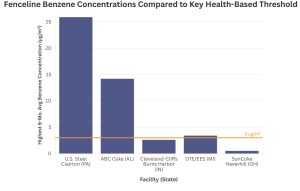
An air pollution monitor at the fenceline of the Clairton Coke Works detected a six-month average concentration of benzene in 2022-2023 of almost 26 micrograms per cubic meter – eight times higher than a key public health threshold (the California Office of Environmental Health Hazard threshold for long-term or chronic exposure.)
Several other steel industry plants have also registered potentially dangerous levels of the pollutants benzene and chromium, according to EIP’s report. Benzene can cause blood disorders, harm the immune system, and is a known cancer-causing agent, with links to leukemia. Chromium, a heavy metal, can cause breathing problems, damage the male reproductive system, and cause ulcers. One form (hexavalent chromium) is a known carcinogen, with links to lung cancer.
This shows the need for more monitoring and controls on these emissions – as would be required by 2024 EPA hazardous air pollution rules for the steel industry that the Trump Administration is attempting to put on hold. EIP and allies on August 6 filed a lawsuit to challenge the delays.
One monitor at ABC Coke in Alabama registered six-month average levels of benzene at the facility perimeter in 2022-2023 more than four times the chronic (long-term) health threshold identified in EIP’s report. And the DTE Energy EES Coke Battery in Michigan, south of Detroit, had levels of benzene 13 percent above that threshold at its fenceline. Both of these plants have been hit with numerous enforcement actions over the last five years for violating the federal Clean Air Act (four at the Alabama facility, eight at the Michigan plant), according to EIP’s report.
In northern Indiana, an air monitor at U.S. Steel Gary Works registered levels of chromium at the facility’s fenceline in 2022 that were more than double the chronic health threshold identified in EIP’s report. The U.S. Steel Granite City Works plant in Illinois had levels of chromium 45 percent higher than that threshold that year, and the Cleveland Cliffs Cleveland Works facility had levels a third higher. The U.S. Steel plants in Gary and Granite City are also chronic violators of the Clean Air Act, with seven enforcement actions over the last five years in Gary and one in Granite City the last five years.
Local residents who live near these plants – who offer their views in an online story map released today with the report – say that these chronic pollution levels and violations at the steel industry plants illustrate the need for the Trump EPA to keep the 2024 hazardous air pollution control and monitoring rules in place.
Terry Steagall, a retired steelworker and union activist in Gary, Indiana, said: “We’ve got to demand a future with clean, sustainable steel that keeps our jobs and communities safe here in Northwest Indiana. EPA’s decision to delay critical rules designed to protect us from toxic emissions perpetuates the unfortunate trend of treating the region as a toxic sacrifice zone for industry to poison the land, air, water, and people.”
Germaine Patterson, a resident who lives near Clairton Coke Works in Western Pennsylvania, said: “This disheartening news of EPA’s emissions monitoring rollbacks comes alongside the recent diagnosis of another cherished community member with cancer. Any company that truly values the well-being of the community it operates in should see this added layer of protection as not just necessary, but the right thing to do.”
Qiyam Ansari, Executive Director of Valley Clean Air Now in Pennsylvania, said: “In Clairton and the Mon Valley, we already live with some of the worst air quality in the nation, and benzene from the steel industry is a major contributor to the toxic burden our bodies carry. Continuous air pollution monitoring is a public health necessity. Removing the requirement for monitoring means children, seniors, and people with respiratory or immune conditions will breathe harmful chemicals without knowing it. In effect, the rollback allows industrial polluters to operate without accountability.”
Charlie Powell, Founder and Director of People Against Neighborhood Industrial Pollution in Tarrant, AL, said: “I started this group because I was concerned about the pollution from the two coke plants near the community I grew up in. EPA was right to require these coke ovens to install new hazardous air pollutant monitors. And EPA is wrong now to tell them that the coke ovens don’t actually have to start doing this monitoring.”
For a copy of EIP’s report, click here.
For a copy of the accompanying storymap with facts about local steel industry facilities and quotes from local residents, click here.
Media contact: Tom Pelton, Environmental Integrity Project (443) 510-2574 or tpelton@environmentalintegrity.org
The Environmental Integrity Project is America’s environmental watchdog. We hold polluters and governments accountable to protect public health and the environment.
