


For a copy of the report, click here. For audio of the online press conference, click here and here.
Washington, D.C. — At least 74 natural gas-fired power plants are planned across the U.S. to provide energy for the rapidly-growing data center industry that could release as much climate-warming pollution as the nation of Australia each year.
These proposed gas plants, which would be dedicated to serving data centers, are expected to generate 143 gigawatts of electricity – enough to power the state of California nearly three times over – along with 662 million tons per year of greenhouse gas pollution, according to a new Environmental Integrity Project report, “The Power Behind AI.”
Many of the plants would be built in parts of the country already struggling with low incomes and premature death, and could worsen local public health by releasing 159,142 tons a year of health-damaging air pollutants, including 44,281 tons of nitrogen oxides that contribute to smog and lung damage and 32,684 tons of fine particulate matter, which can trigger heart and asthma attacks.
“An industry of the future should not be chained to dirty fuels of the past and the air pollution from fossil fuels that cause real harm to communities,” said Jen Duggan, Executive Director of the Environmental Integrity Project. “While data centers may be needed to accommodate shifts in technology, the public has a right to transparency and accountability, clean air, and common sense controls to protect water supplies, especially in areas already struggling with water shortages.”
Alex Bomstein, Executive Director at Clean Air Council, said: “In their wholehearted embrace of dirty and outdated gas power, data center developers are announcing to the public that they don’t care about us. We deserve better than decades of toxic pollution, parched streambeds, and climate chaos.”
Nikki Forrester, Director of Communications for Tucker United in West Virginia, said: “Air pollutants from the proposed gas- and diesel-fired power plants are known to cause cancer, heart disease, and premature death, among many other risks. No data center project should compromise our health, clean air, water, or quality of life.”
Beyond the pollution impacts detailed in EIP’s report, data centers and their gas-fired power plants are also thirsty consumers of water, with some demanding millions of gallons of water per day. Despite this problem, about two thirds of the data centers built or planned in the U.S. over the last four years are located in water-stressed regions.
The 74 planned gas power plants, including 71 new plants and three expansions, documented in EIP’s report would be connected directly to data centers — so-called “behind-the-meter” power plants. These plants are designed to provide their electricity primarily to data centers rather than to a broader electricity grid.
More power plants are being planned across the U.S. that will indirectly serve the growing data center industry along with other consumers on the grid, with the competition driving up electricity prices for nearby residents in some cases. Behind-the-meter gas-fired power plants can also increase electricity bills for consumers because they increase demand and prices for limited supplies of natural gas and power generation equipment.
Of the 74 proposed gas plants dedicated to data centers examined in the EIP report, 32 are in Texas, 10 are in Ohio, seven are in Pennsylvania, four are in West Virginia and four are in Wyoming.
The report includes profiles of local communities fighting massive data center projects in Tucker County, West Virginia; South Memphis, Tennessee; Homer City, Pennsylvania, which is east of Pittsburgh; and Amarillo, Texas.
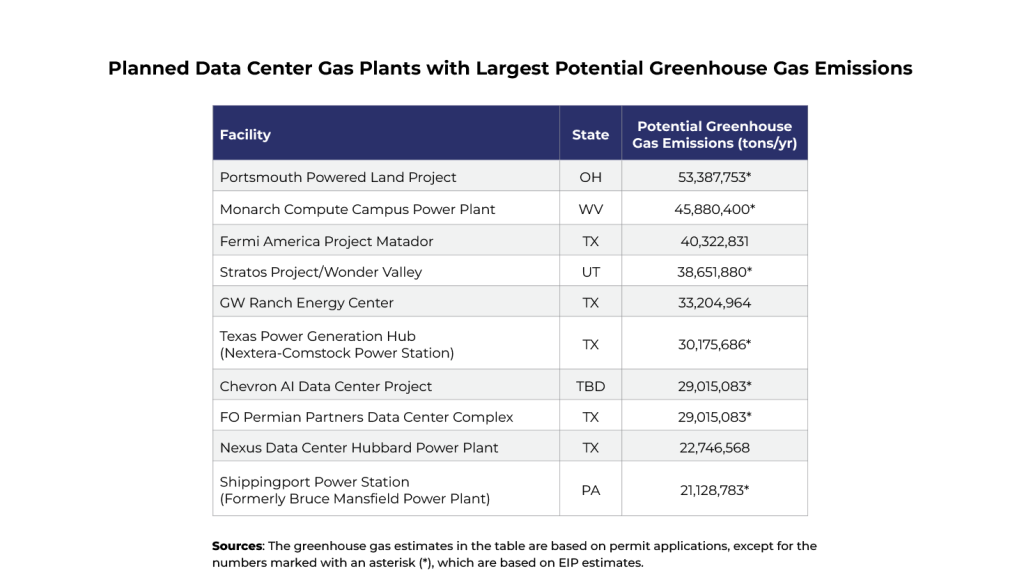
In this last example, Fermi America is planning an immense power plant in sparsely-populated West Texas. The facility would have enough generation capacity to power New York City for a data center complex nearly three times the size of the Pentagon called the “President Donald J. Trump Advanced Energy and Intelligence Campus.” The 141 gas-fired turbines at this plant could release 40 million tons per year of greenhouse gases – as much as eight million cars and trucks driving for a year – as well as nearly 10,000 tons per year of health-harming air pollutants, including soot and smog-forming nitrogen oxides.
An analysis of the demographic and health outcomes in the communities surrounding the proposed gas power plants revealed that many already struggle with poverty and poor health, which could be worsened by the additional air pollution. Of the plants with known locations and available data:
- Forty percent of the population (223,489 of 562,825 people) living within three miles of the proposed gas plants with enough data available (67 plants) are in low-income households.
- About 88 percent (62 of 70) of the proposed plants with known locations are planned or under construction in counties where the life expectancy is already below the 2020-2022 U.S. average of 77 years, with the life expectancy in these areas on average, two to three years lower than average. Life expectancies tend to be shorter in areas with higher rates of poverty, chronic disease and drug use. Only eight plants are planned for counties where life expectancy exceeds the national average.
- In some places where these projects are proposed, the gap in life expectancy is large. For example, in Mingo County, West Virginia – where the Adams Fork Data Center Energy Campus is planned – the life expectancy is 11 years lower than the national average.
- At least 188 schools are located within three miles of the proposed gas power plants dedicated to data centers, risking the health of children and adolescents.
The report also lists and ranks what would be the largest polluters among the 74 proposed gas plants for the data center industry. The very largest, in Ohio, the Portsmouth Powered Land Project south of Columbus, could emit 53 million tons of greenhouse gases per year, more than all of New York City (which released 48 million tons in 2024).
The report concludes that while some additional data centers may be needed to accommodate shifts in technology, these centers should be powered by clean energy, including solar farms and wind turbines with ample battery storage systems for when weather conditions are poor.
Companies should also avoid building data centers in areas like West Texas that are struggling with water shortages and they should be required to implement technologies that minimize water use for cooling and power generation, according to the policy recommendations in EIP’s report.
For a copy of the report, click here.
Media Contact: Tom Pelton, Environmental Integrity Project, tpelton@environmentalintegrity.org, (443) 510-2574
The Environmental Integrity Project is America’s environmental watchdog. We hold polluters and governments accountable to protect public health and the environment.
