Living in the Shadow of Fracking

Stories and photos of families in Southwestern Pennsylvania and Western Maryland

The Environmental Integrity Project teamed up with the International League of Conservation Photographers to tell stories of six families who live every day in the shadow of fracking. Three families from Pennsylvania have experienced how the fracking boom industrializes rural countryside, disrupts their quality of life, and damages their health. Three from Western Maryland feared the industry would march southward from Pennsylvania if Maryland lawmakers fail to pass legislation extending a moratorium on fracking in the state that expires in October 2017. Maryland has since passed a legislative ban on fracking, marking a great win for the state and point of relief for residents in Western Maryland.

Jane Worthington

After Her Daughter Gets Sick, a Mother Fights to Protect Her School from Fracking

The Durans

Farm Family May be Driven from Land by New Crop: Gas Processing Plants

Dr. Marsha Haley

Physician Diagnoses New Health Risk: Explosions at Drilling Sites

Nadine Grabania and Paul Roberts

Winery Owners Fear Fracking Will Poison Tourism

The Dubanskys

Organic Farmers Don’t Want Drilling on Their Doorstep

Jess Whittemore

Kayaking Gear Designer Fights Current on Fracking

LIFE IN FRACKING’S SHADOW

Slideshow

Hydraulic Fracturing and How it Threatens a Way of Life in Western Maryland and Pennsylvania
Western Pennsylvania farmer Vicki Duran holds a photo of four of her five children. Since the arrival of fracking, their family farm has been surrounded by gas wells, compressor stations and processing plants. Hundreds of tanker trunks and other heavy vehicles now roar down their narrow country lane every day. Because of the loss of their quality of life, the Durans worry they will be driven off their land.
As fracking sparked a shale gas boom, the new crops that sprouted up all over farmland in southwest Pennsylvania are drilling rigs, well pads, tanks, pipelines, and gas processing plants. These are condensate tanks at a Range Resources well pad in Washington County, Robinson Township.
Alexis Elliot, a 13-year-old from Mount Pleasant Township, Pa., suffered nosebleeds, eye infections, discoloration of her hands and excessive thirst after drillers started fracking several wells around her school. Her urine tested positive for benzene, a carcinogen that is sometimes used in the hydraulic fracturing process.
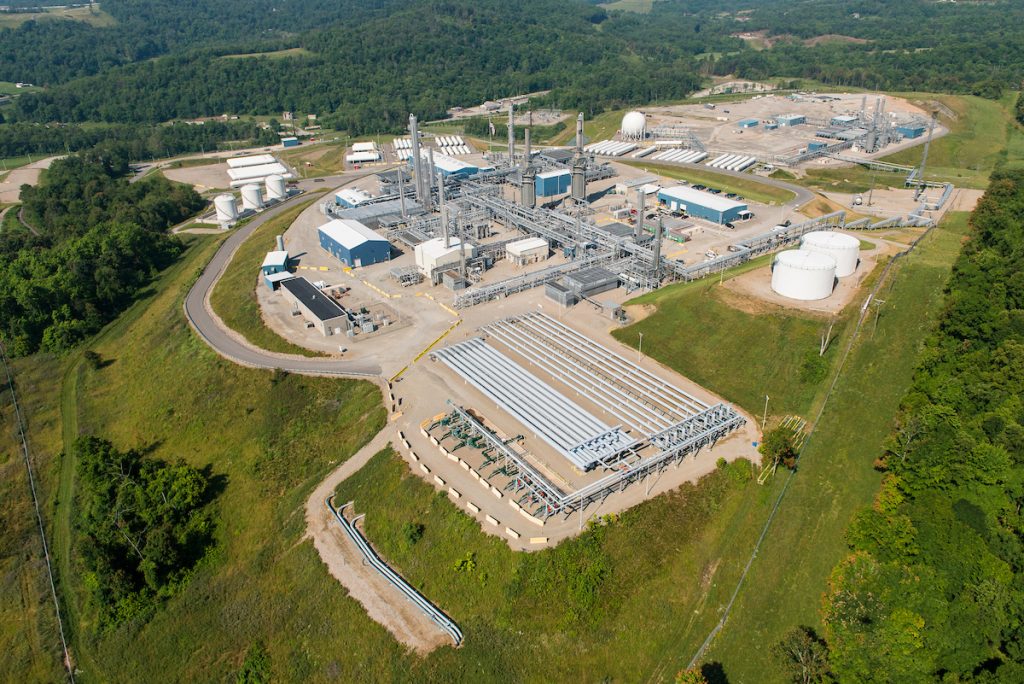
In what was once a quiet farming area in western Pennsylvania, the MarkWest cryogenic fractionation plant in Chartiers Township has been expanding rapidly. The plant, which processes natural gas products, is an example of the massive industrial infrastructure that follows hydraulic fracturing.
Western Maryland winemaker Nadine Grabania visits Buffalo Run Creek in Friendsville and looks upstream and into the future. Although there is no fracking in Maryland yet, a moratorium on the practice will expire in October 2017. Nadine and others worry the oil and gas industry will move south from Pennsylvania and pollute their streams and destroy their quality of life.
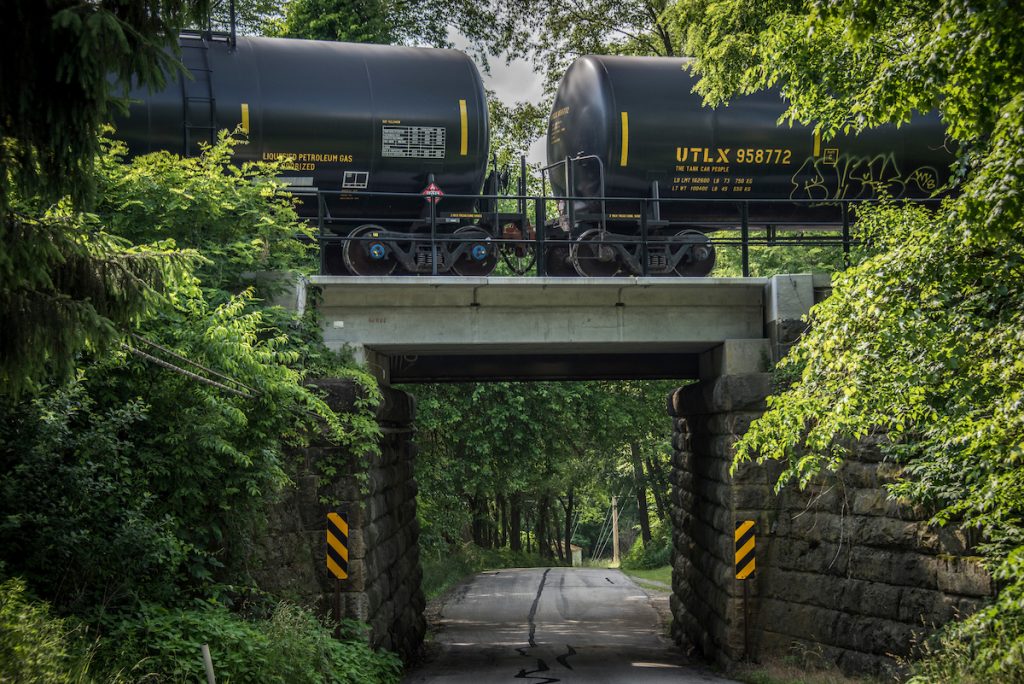
A train filled with oil and gas rumbles through Mount Pleasant Township, Pennsylvania. Called “bomb trains” by locals because of their potential explosiveness, such shipments have become much more common through communities in Western Pennsylvania as fracking has multiplied wells and processing plants.
Western Maryland organic farmer Katharine Dubansky and her daughter Tessa, 6, work in the fields of Backbone Farm, which is surrounded by land leased in recent years by gas companies. Some leases have expired, but Katharine worries that if the state’s moratorium on fracking is lifted, the industry will move in and pollute the land, air and streams.
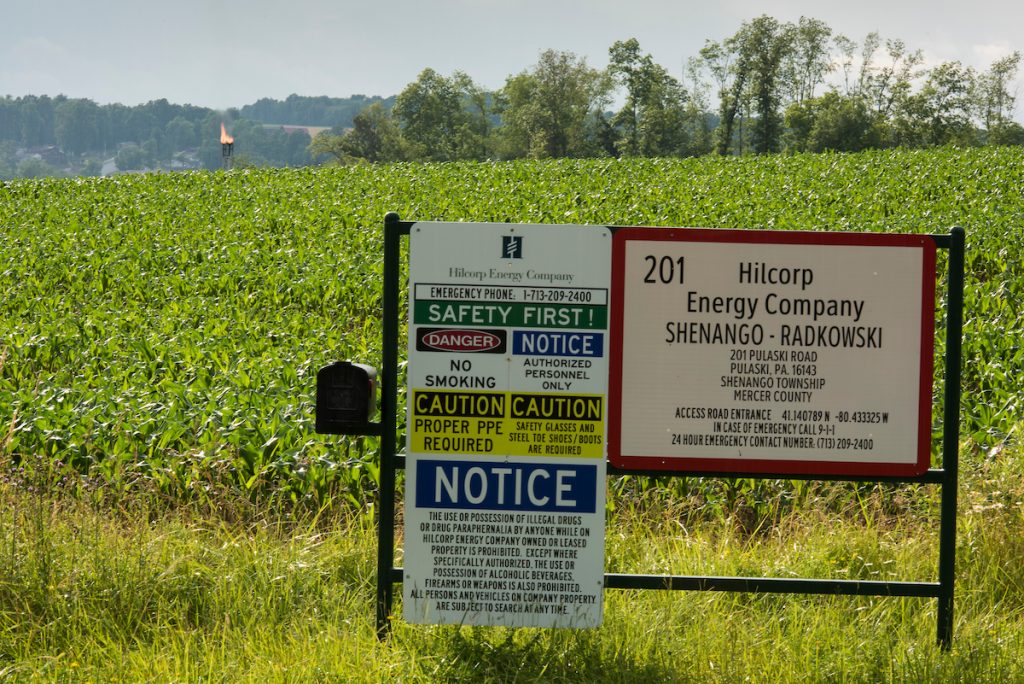
In Western Pennsylvania, the landscape of many farms has already changed. Here, a flare burns natural gas from a well near a cornfield in Pulaski Township, Lawrence County.
Dr. Marsha Haley, a radiation oncologist from Butler County, Pa., stands outside a drilling pad walled by sound barriers to dampen the loud noise. Haley and colleagues recently published a scientific journal article about the dangerous closeness of fracking “blast zones” to public buildings including schools like the one attended by her 10-year-old daughter.
Rural areas of Pennsylvania that once had little traffic now face traffic jams because of the large number of tanker trucks required for hydraulic fracturing. Many of these trucks carry explosive materials, putting families, farms, and businesses in potential danger. Western Maryland’s narrow roads could see similar traffic jams if the state’s ban on fracking is lifted.
In Lawrence County, Pa., the rolling farm fields are increasingly broken up by the infrastructure of the oil and gas industry. A common sight are elbows of pipe that protrude from the ground called “pig launchers,” which often leak methane pollution.
In Washington County, Pa., Karen Brockman worries that air pollution from enormous compressor stations being built near her home will jeopardize the health of her husband, Gary, who recently underwent a double lung transplant. She and her neighbors in Midway Borough are fighting to slow the industry’s growth and protect public health.
Karen and Gary Brockman in their home in Midway Borough, Pa., with medications that Gary takes for his lungs.
Across the street from the Brockmans’ house, Mark West Energy’s massive Cibus-Imperial natural gas compressor complex is under construction in Robinson Township, Pa., one of the largest ever built in the region. Many local residents are trying to protect their once peaceful, rural community from the multiplying number of industrial facilities like this.Across the street from the Brockmans’ house, Mark West Energy’s massive Cibus-Imperial natural gas compressor complex is under construction in Robinson Township, Pa., one of the largest ever built in the region. Many local residents are trying to protect their once peaceful, rural community from the multiplying number of industrial facilities like this.
In an effort to stop the onslaught of the gas industry into New Wilmington Township, Pa., Carrie Hahn (left) volunteers with the Citizens Alliance Upholding a Safe Environment (CAUSE), which is seeking a ban on fracking in the township. She examines drilling sites with Lisa Graves-Marcucci of the Environmental Integrity Project.
In Smith Township, Pa., advocate Cat Lodge (left) and Lisa Graves-Marcucci of the Environmental Integrity Project (right) stand for the Pledge of Allegiance before the start of a public hearing on oil and gas expansion issues. They have been organizing local residents and helping them fight back against the powerful industry.
In Western Pennsylvania, farmer Dan Duran gazes across his fields and worries about two massive cryogenic natural gas processing plants proposed near his home. He fears the noise and pollution will drive him off his land, and that his newborn son will lose out on the family’s farming legacy. Similar anxieties may be shared by farmers in Maryland, if a ban on fracking is lifted there.
Trump Watch: EPA
EIP is working to increase transparency, raise awareness, and hold the Trump Administration and Scott Pruitt accountable for their actions.
Learn More
593 EPA veterans demand investigation of Trump political abuse of epa authority
Letter to U.S. House Questions Why Trump EPA Threatened California while Ignoring Other States with More Violations
Learn More

A Cautionary Tale About the Oil and Gas Industry.

Hydraulic fracturing for natural gas and oil has transformed the American landscape over the last decade, triggering booms in production, making a few people rich, and creating some new jobs – but also inflicting a terrible toll on many rural families and public health.
Farmers who for generations have lived in peaceful partnership with the landscape are having their quality of life shattered by loud drilling rigs and flares, tanker trucks at all hours of the night, air pollution, even children and animals suffering mysterious illnesses.

Some of these families and communities are trying to push back, and many are in the midst of debate over legislation and local decision-making that would restrict shale gas development. But they face fierce and well-funded opposition from the oil and gas industry and their allies in state legislatures.

New York State banned fracking in 2015, and Maryland has a temporary moratorium in place that will expire in October 2017. An intense political fight is expected this winter in Maryland over legislation that would permanently outlaw the high-powered injection of water and chemicals into shale rock formations to extract fuel.

In these debates, numbers are often thrown around – numbers of dollars, jobs, gallons, exports, imports. But what is often lost is what matters the most in a democracy: the people who have to live with the decisions.

To shine a light on this issue, the Environmental Integrity Project teamed up with the International League of Conservation Photographers this summer to tell stories, through photojournalism, of six families who live every day in the shadow of fracking. Three of the families are from Pennsylvania – farmers, a doctor, a nurse and their children – whose quality of life and sometimes health have been disrupted by the proliferation of drilling rigs and industrial plants that have followed the fracking boom. Three of the families are from Maryland – winemakers, organic farmers, and a river rafting company owner – who fear that the oil and gas industry will march southward from Pennsylvania if the Maryland General Assembly fails to pass legislation extending a ban on fracking in the state. It’s a cautionary tale: Western Maryland looks today as rural western Pennsylvania looked prior to the fracking boom.
The stories showcase multiple, brave people who refuse to give up or back down, and are organizing to fight for their farms and families.  Their concerns touch on issues that extend far beyond state borders to broad questions that all Americans face today:  How much power should average citizens and local governments have to determine the character of their communities?  Is it the people or industry that decides the quality of our lives?

The narratives were written by EIP Deputy Director Mary Greene and captured in images by Karen Kasmauski and Garth Lenz of the International League of Conservation Photographers.